

State govs urged to establish anti corruption agencies to complement CCT, EFCC
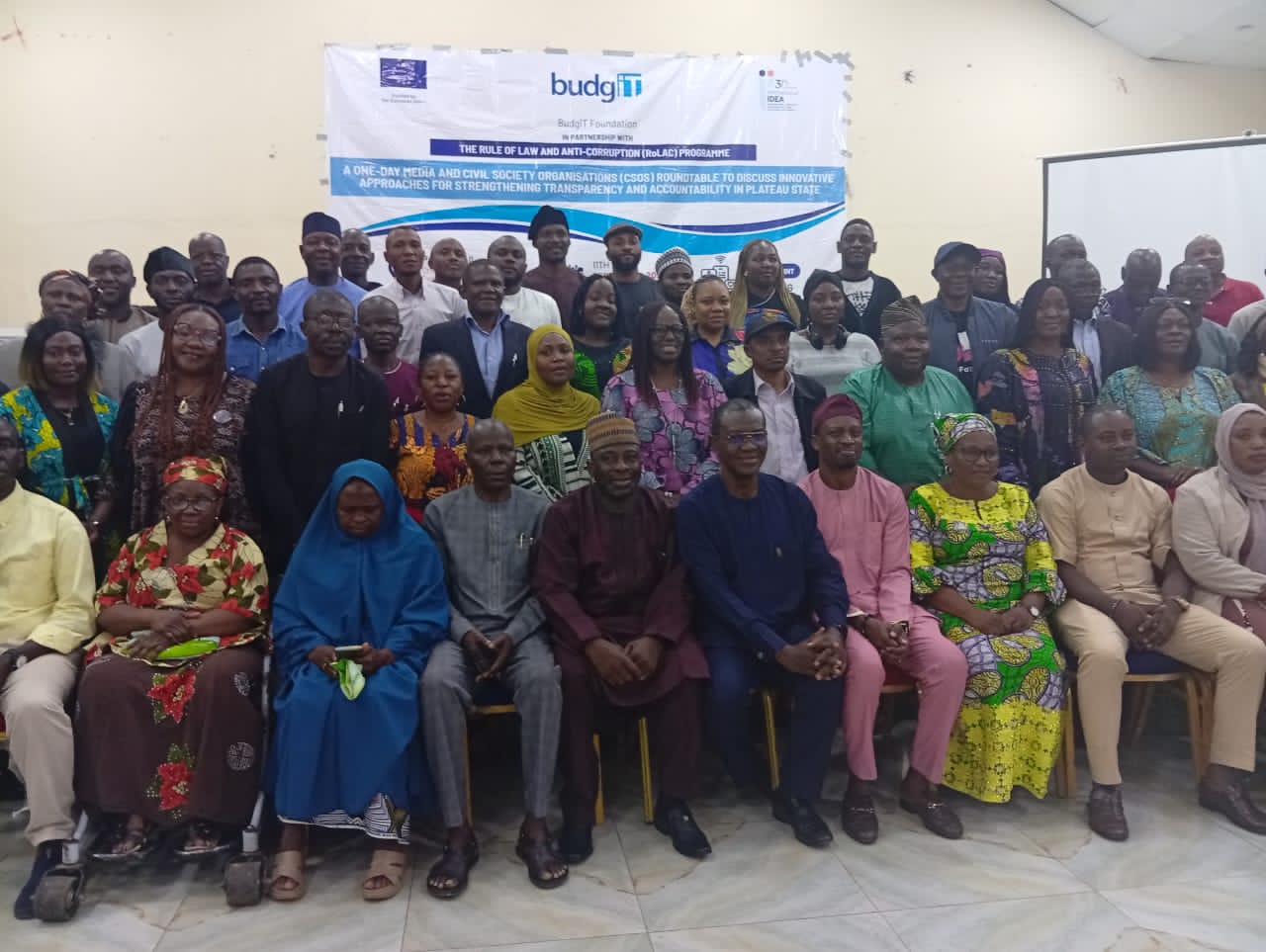
Stakeholders at a roundtable on innovation for strengthening transparency and accountability in Plateau state have charged state governors to establish anti corruption agencies in their various states.
This, they said, will complement the efforts of the Code of Conduct Tribunal, the Economic and Financial Crimes Commission (EFCC) and other anti graft agencies in the fight against corruption in the country.
The programme was organised by BudgiT Foundation with support from the Rule and Anti-Corruption (RoLAC) Phase II programme with support from the European Union.
While BudgiT is focused on stimulating citizens and enabling their right to demand accountability, institutional reforms, efficient service delivery, and an equitable society, RoLAC seeks to contribute to the consolidation of the rule of law and anti-corruption reforms in Nigeria through support to strengthened coordination and collaboration amongst relevant stakeholders (ACAs, MDAs, CSO, media and private sector).
Anti Corruption Program Manager, International Institute for Democracy and Electoral Assistance (Inter IDEA), Dr Emmanuel Uche, speaking at the one day round table organised for media and civil society organisations in Jos, said that the success story of five states that had taken the lead in this direction showed that corruption could be greatly reduced if fought at state level.
Uche noted agencies like CCT and EFCC have been overwhelmed with the number of corruption cases at the federal level, stressing that the establishment of such agencies at state level will mitigate such challenges.
He said, “How do you explain that a Code of Conduct Tribunal will have only six people sitting in abuja to oversee 200 million people with code of ethics that is failing every day. How do you explain that? That means it was never designed to work now you tie Code of Conduct Bureau to that it fails on arrival because not everything CCB investigates is supposed to be prosecuted by CCT. CCT does not have capacity six people adjudicating over 200 million people.
“So having state-level anti-corruption agencies is a better alternative. At first, you might think it will be used by state governments either to cover their tracks or to perpetrate their own issues. That’s fine. That’s exactly how the roadmap in the fight against corruption starts.
“This government uses it against its opponents. The next government will use it against the current government who will then be in opposition.
“So, at the end of the day, in the short run, it might have challenges. In the long run, it will only get better.
“The movement is to establish state-level anti-corruption agencies, which is part of what is coming out from our support to subnational implementation of the National Anti-Corruption Strategy.
He said that di far five states have taken the lead in this regard, adding,
“Today Kano has the Kano Public Complaints and Anti-Corruption Agency, people thought it was a lame duck but before our very eyes we saw the governor get into fight with the chairman, suspended him for almost close to a year but the Supreme Court reinstated him and he is there probing the same governor that appointed him.
Group Head of Research and Policy Advisory, Budgit Foundation, Vahyala Kwaga, such anti corruption agencies are necessary to give fight for corruption a good teeth at the sub national level.He said that Nigeria needs to position itself where strategies for governance, strategies to evaluate and monitor service delivery, strategies that enshrine globally accepted and locally accepted norms and practices are normal “It’s normal for them that these anti corruption strategies are given a resounding pronouncement at the subnational level.
“These states are where Nigerians live. And if the global best practices and even local strategies are not presented and argued for and made a case for at the state level there will be very little or minimal buy-in.
“So today’s event essentially wants to bring together several key stakeholders in society civil society and media on one hand and the government on the other for there to be a co-creation of anti-corruption, of transparency and accountability frameworks and initiatives for Plateau state.
“Unfortunately, most of the attention for transparency and accountability initiatives actually ends up on the desks of civil servants because they are the ones that implement public policy day to day. “Politicians really are here for a four year cycle, etc.
“While civil servants are there for 10, 15, 20, 30 years. So their work is of a different nature and their incentives, their motivations could be different in some contexts.
“So what we want are tailor made, specific to the Nigerian context, need to know basis interventions that all parties will see as, that the parties will not see as burdensome or too much and would be willing to buy into. While admitting that corruption cannot be eliminated totally because of lack of mechanism to monitor everyone, Kwaga however believes that it can be limited to a negligible level.
In her goodwill message, the Executive Director, Kaneng Rwang Pam Foundation for Education and Migration Awareness, Kaneng Rwang Pam, said that discussions would act as the starting point for this necessary change.
She said, “The ideas and collective insights shared here will not just be abstract concepts; they will be the raw materials for real, tangible reforms.”
Rwang Pam, represented by Gyang Botsha, said, “Our findings consistently show that while policies may exist on paper, their implementation and the level of public awareness about them are often lacking. We’ve been a strong advocate for a robust anti-corruption framework for Plateau State that goes beyond mere legislation. It must be a framework for action, one that is both systemic and people-centric. We’ve suggested concrete steps like strengthening existing legal provisions to be more adaptable to emerging challenges, promoting citizen-led oversight of public projects, and leveraging technology to create open data platforms that make government spending easily accessible to every citizen.”
The event was attended by civil society organisations, media, and representatives of the judiciary.